
The First World War Mod: Germany and Diplomacy
It’s been a long time since my last update on the First World War mod, but not for a lack of effort. My next step has been to create the focus tree for the most pivotal country of the period: the German Empire.
A huge amount of history has been written on Germany from 1914. Recognised to be the most powerful land-military of the era, and the most capable army per-capita by quite a margin, Germany fought a fierce war despite its floundering allies in Vienna and Istanbul and, on the occaisions of the 1st Marne, Brest-Litovsk, and finally the Ludendorff offensive, victory over the colonial powers seemed within its reach.
Held chiefly responsible in the ink of Versailles for the four years of slaughter, Germany has been (without dispute, this time) the architect of a second World War, the faultline of the cold war, and finally the heart of the European Union. Debates over the 2nd Reich’s war guilt, its continuity with the National Socialists, and how close precisely it was to victory in 1918 rage to this day.
Despite this wealth of research material, plugging together a German focus tree has proven difficult. It drove me to re-invent two of vanilla HoI4’s key systems: politics and diplomacy. Adapting these systems to meet the needs of the First World War mod has taken much of my time, though I knew from early in development I wanted to do it.
Encirclement
I’ll paint a picture of pre-war Germany.
Unified, with some reluctance, in 1871 by the diplomatic and martial politicking of Otto von Bismarck (it was only after a war with first Austria, and then France, that the kingdoms and duchies of Germany could be coerced into federation), the 2nd Reich boomed onto the world stage an industrial and scientific juggernaut.
Beggining with the Gründerzeit (Founder’s Years) of 1871, by 1910 Germany had eclipsed Britain in machinery exports, and its burgeoning fleet of battleships threatened the British monopoly of sea power - this was the famous naval arms race, one of many thorns in Anglo-German relations before the war. More on this shortly.
In fact, the one thing Germany found itself in short supply of was powerful allies. Following the dismissal of Bismarck by the new and energetic emperor - Kaiser Wilhelm II - Berlin’s diplomatic security began to slide.
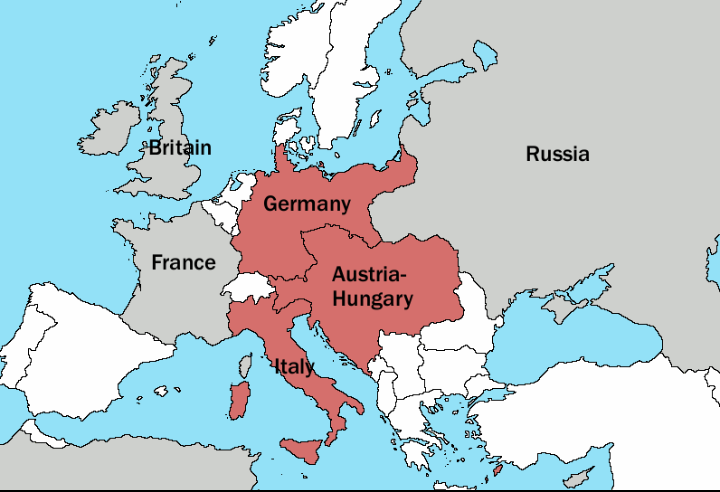
World War 1 commenced with two opposing power-blocs of three, but anyone familiar with the war will know that Italy’s commitment to the ‘Triple Alliance’ was only ethereal. Lawmakers at the time also knew this.
The Isolation of Berlin
Under Bismarck, the League of the Three Emperors - namely the German, Austrian, and Russian emperor - had served as a conservative counter to the liberal west as well as keeping France isolated, but this treaty was not renewed in 1887. German-Russian relations soured over time due both to Russia’s interests in the Balkans colliding with Austria’s, and because the Kaiser sought to placate the German agrarian-aristocrats (the Junkers) by imposing tarrifs on Russian grain. What followed was a Russian realignment towards France, and the begginings of the Entente.
What remained was the ‘Triple Alliance’ between Germany, Austria, and Italy. But here too, Austrian interests caused friction in the alliance: Rome and Vienna both competed in the Adriatic, while a sizeable Italian population remained irredeemed under Austria. It was little surprise to anyone when Italy joined the war on the side of the Entente only a year after the Archduke’s assassination.
From three powerful allies to one, and from one powerful enemy to two, with the remaining Britain and Italy both increasingly inclined towards the Entente. Berlin now faced diplomatic catastrophe.
“The famous encirclement of Germany has become a complete fact. We squirm isolated in a net,” Wilhelm was to lament during the July crisis.
Despite this dire situation, the ‘alt history’ space for new German allies is very rich.
Britain may have been brought onside, had Germany conceded the naval arms race. The British feared Russia above all as a rival in south Asia (in fact, their fear of Russia was part of their motivation to side with the Entente).
Russia may have been recovered by the personal relationship between the Tsar and the Kaiser (who were cousins), as well as the drive for an international conservative bulwark in both countries. A weak attempt at exactly this was made with the Treaty of Björkö in 1905.
France may have been placated by the return of Alsace-Lorraine.
Italy may have been favoured over Austria in the Triple alliance, or the two powers’ disputes may have been settled in the Adriatic.
Repurposing Ideology (Again)
I’ve written in my post on Russia about my feelings that the vanilla HoI4 ideology system doesn’t represent the first world war. To recap:
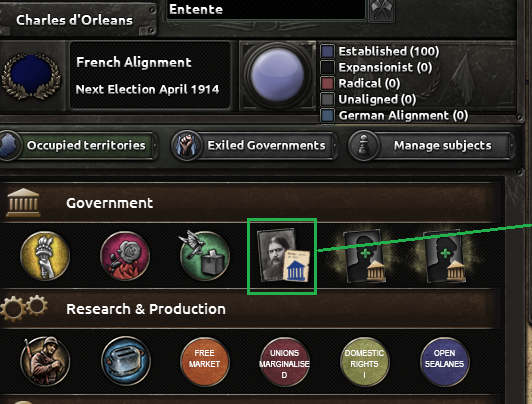
HoI4 combines ideology and diplomacy.
The ideology that rules your country determines both what laws you can pass, and who wants to be your ally.
This suits World War 2, where there was a strong ideological dimension to which countries supported one another (Italy and Germany supported Franco, for example).
It doesn’t suit World War 1, where the chief powers of the Entente were the famously progressive French Republic and the rigidly backward Russian Tsardom.
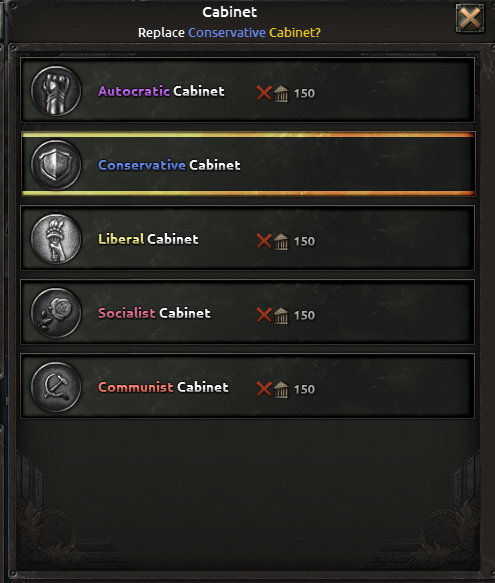
For this reason, when making that post, I resolved to move ideology into a type of law (see right)
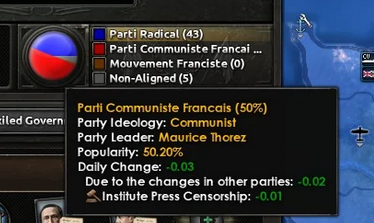
Meanwhile, the ideology pie chart became ‘diplomatic leaning’. Three pseudo-ideologies took the place of the vanilla ones (see below).
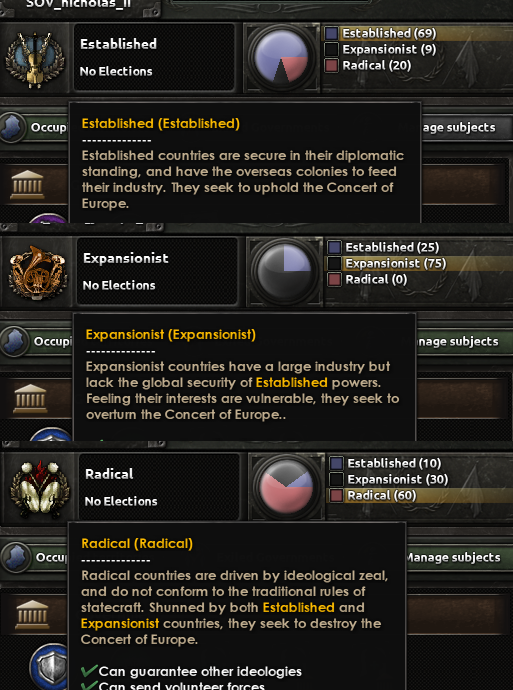
This was my plan for the mod. But over my research, I’ve found it to have some drawbacks.
The three pseudo-ideologies are too abstract. Communism, fascism, and liberalism were actual ideological forces present in WW2 (whether they drove diplomacy in the way that Hearts of Iron IV implies is up for debate).
What’s so ‘expansionist’ about Germany, or Austria? The idea is that these two powers lacked maritime security, so they were driven to overturn the order of Europe. This brought them into conflict with the ‘established’ powers of Britain, France, and Russia.
But this gets sloppy. My best example is the Serbian Black Hand, which are certainly ‘expansionist’: Serb nationalists wanted desperately to expand the country. Maritime security was even one of their concerns - they sought a coast in Albania for this reason. Yet the Black Hand was obviously no friend of Austria, or of Germany.There isn’t any history about ‘Expansionist’ and ‘Established’ diplomatic leanings. These groupings are based on real history - it’s often observed that the Central Powers was composed of great powers which lacked a colonial empire.
But this model doesn’t lend itself to content, in particular, content I’d want to use in focus trees. There was no ‘Expansionist Pact’ or ‘3rd International of Established-ism’. Britain didn’t have an ‘Expansionist lobby’ to speak of in its politics. Meanwhile, Britain certainly had both Communist and Fascist movements, which the vanilla game draws on successfully.
This second point can’t be stressed enough. As I researched, I found myself with heaps of historical events pertaining to diplomatic influence - the Haldane Mission, the Serbian royal visit to Paris, Russian Pan-Slavism. I didn’t have any historical events pertaining to my 3 diplomatic alignments. What was I going to put into my focus trees?
This is why I decided to overhaul my implementation of Diplomacy.
Soft Power & Spheres of Influence
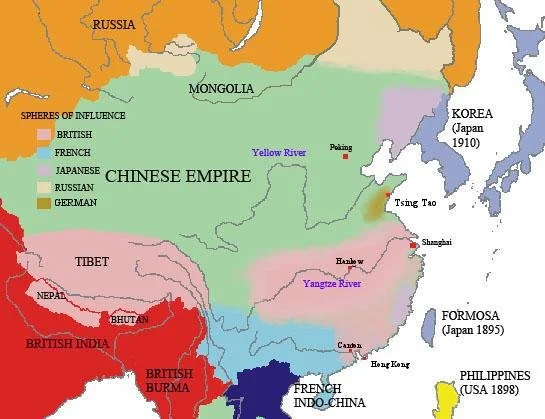
Chinese regions of influence are an example of the ‘sphere of influence’ in the long 19th century.
Internatiuonal relations in this period are often spoken of in terms of a ‘sphere of influence’.
A great power exerts soft power over client states, and you get a ‘soft empire’, where territories not necessarily administered or annexed by a European colonial power are nonetheless subservient to one.
It’s this principle I want to use in my redesign of diplomacy. No longer ideologies, or pseudo-ideologies, an ‘ideology’ now represents the influence of a single Great Power. In effect, each Great Power in the WWI mod gets its own ideology.
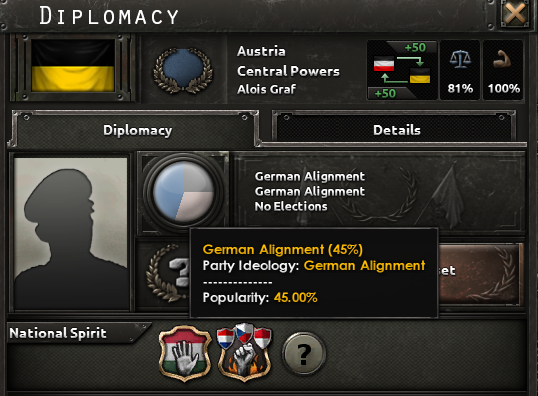
Below, we see Bulgaria’s alignment values in 1911. Russia holds the most sway, but over the Balkan Wars it will historically be outdone by German influence. Austria, too, holds some power in Sofia.
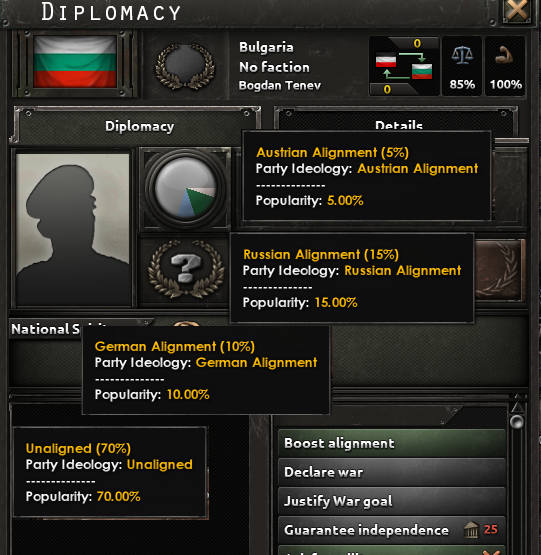
As in vanilla, when an ideology becomes prevalant enough, it will become the ‘ruling party’ of the country. This is something like bringing a country into your sphere.
Once in your sphere, the country is much more inclined to join your faction.
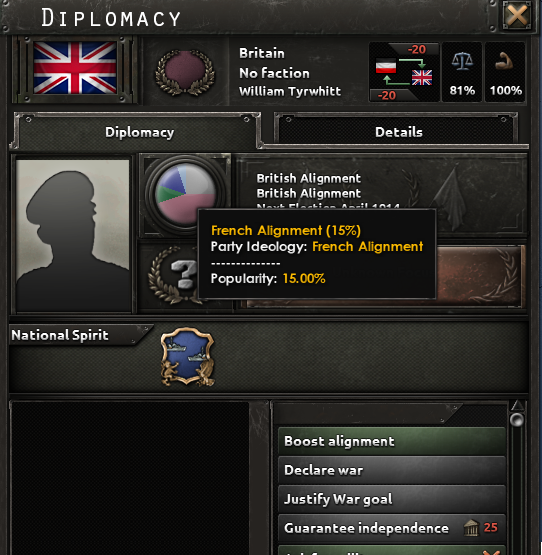
Great Powers themselves are also influenced by alignment. If a Great Power’s biggest ideology is its own alignment, we can think of it as the country wanting to direct its own international affairs and maybe found its own faction. Austria begins under German alignment, but with some focuses it can quickly switch to its own alignment and found its own faction.
Britain in 1911 is master of its own foreign affairs, but will move towards French and Russian influence as the Entente strengthens - do this quicker than usual, and you can join them whether Belgium is invaded or not.
Modelling things this way has a lot of advantages.
Creating focuses is easier. Numerous historical events can be modelled as ‘increasing your influence somewhere’.
Painting the pie chart your colour feels good. As a HoI4 player, I really enjoy flipping minor countries to my ideology, potentially opening new fronts and changing the nature of a war. It’s satisfying in a paint-the-map sense.
It makes room for some interesting diplomatic advisors. There was a ‘germanophile’ and ‘germanophobe’ contingent in the British foreign office in 1914, for example.
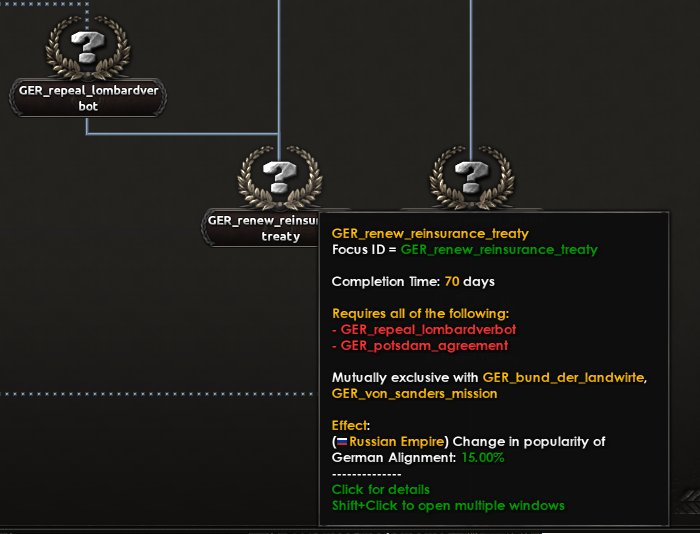
There are also some issues I need to work out. For example, if I’m Russia and I have French alignment, can I boost French influence in other countries as well as my own?
If I need 50% Entente influence to join the Entente, and I have 30% from France and 20% from Russia, can I join?
I’ve yet to work these out. But already I’ve found playing more engaging with this change.
Das Grossmaul
Returning to Germany, I mentioned the role of Kaiser Wilhelm II in its foreign policy.
Wilhelm has a very well studied, even famous, relation to Germany in this period. A maverick, a show-off, and an all-round yapper, he was known before the war for his frequently embarassing public episodes and his bombastic manners. Foreign rulers and diplomats alike dreaded his visits - out of disdain more than fear. If he cornered you, he’d speak endlessly about sailing, imperial ambitions, or any number of his episodic schemes. He wanted to establish a German colony first in Brasil, and then in Mesopotamia. He joked to the king of Belgium that the two countries ought to invade France. He was a big-mouth, or Grossmaul.
He’s also an excellent source of quotes, which I employ extensively in my loading tips. Here are a few Wilhelmisms:
"The Foreign Office? Why, I am the Foreign Office!”
"There is no balance of power in Europe but me ... me and my twenty-five army corps.”
"Well, what do you know, that IS a firm note after all.” (after reading the Austrian Ultimatum)
"You diplomats are full of shit and the whole of Wilhelmstraße stinks.”
As we’ll see in a future post, Wilhelm wasn’t quite the autocrat that Tsar Nicholas was, but he was certainly a stubborn arch-conservative who despised socialists and liberals. I didn’t want to make him centre-stage to a German campaign as I did with the Tsar (the Kaiser’s role in the war famously diminished to the advantage of Hindenburg and Ludendorff), but I did want to represent his bungles mechanically.
I also wanted to mechanically represent Germany’s encirclement.
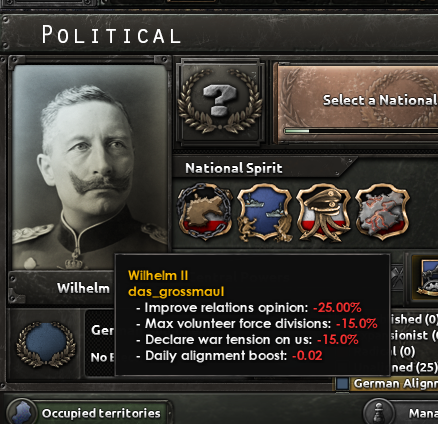
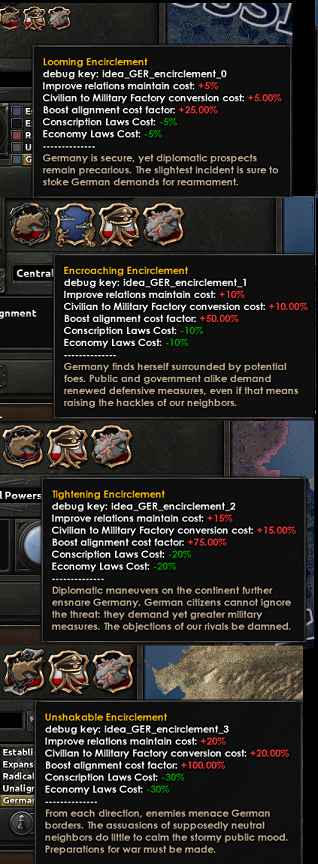
Note Daily alignment boost and Boost alignment cost factor.
Wilhelm reduces the base boost you output onto a foreign country, while the Encirclement level (a tiered idea, which can be increased and decreased in a few ways) increases the political power needed to boost your alignment overseas.
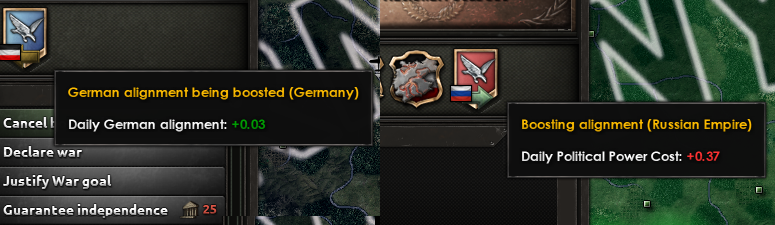
Germany starts the game with less alignment boost due to Wilhelm, and boosting also costs more political power due to the Encirclement idea.
HoI4 players may realise the above UI isn’t how ‘boosting an ideology’ normally looks at all. And experienced modders may recognise that you cannot usually modify the boost power or cost of a country.
To achieve the above, I actually had to remove the standard diplomatic actions for boosting ideology, and re-implement it with my own logic.
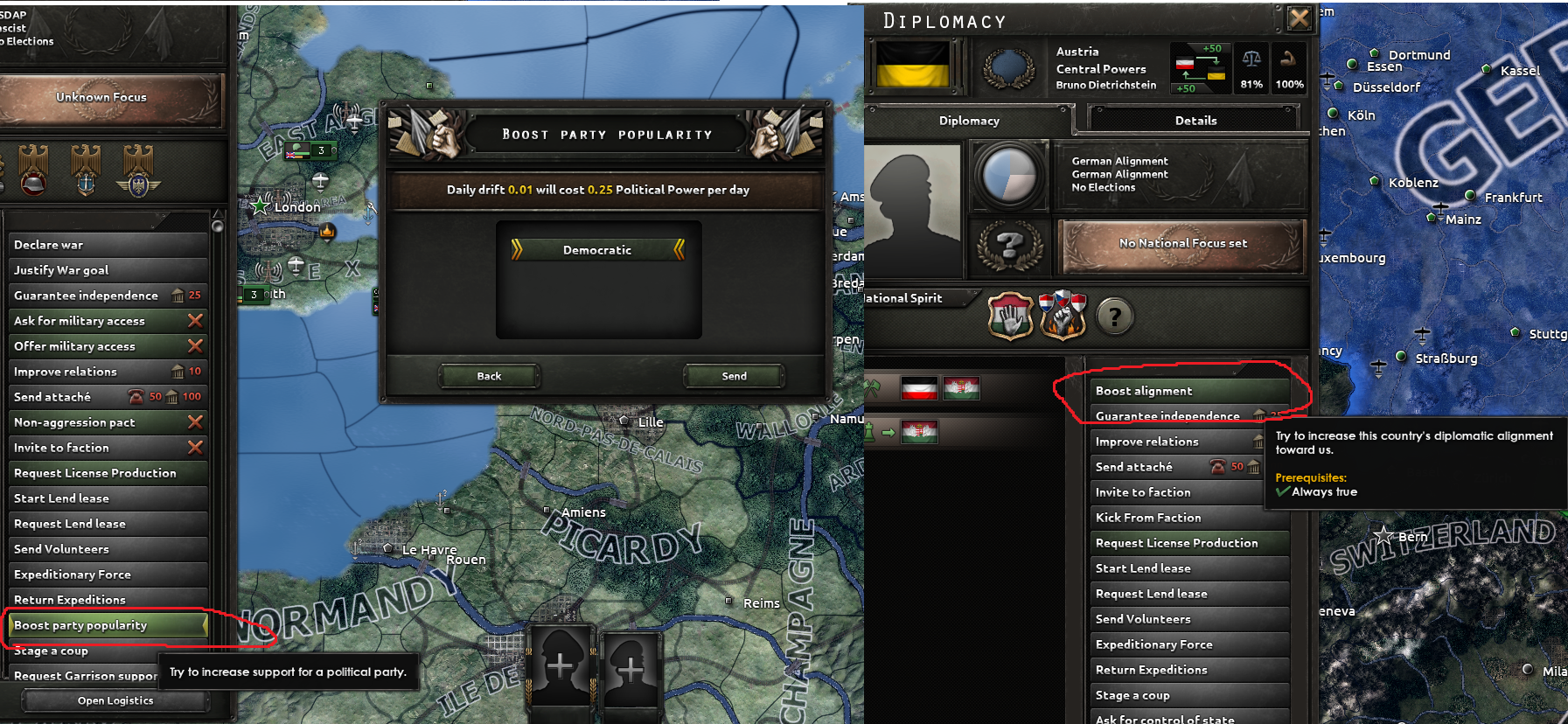
On the left is the vanilla version of ‘Boost party popularity’. On the right, I’ve removed the vanilla option and added my own custom diplomatic action.
This wasn’t easy, but the results are mostly seamless. I think it was worth doing because modifying the power of your ideology-boost over other countries creates a rich content-space.
What if some laws, such as blockade laws, increased your boost output?
What if some advisors reduced the cost to boost?
What if having a trade deal with a country increased your boost with them?
In fact, the need to modify this value had appeared numerous times in my design for Germany (I did the design, realised no such modifier exists, and after some pencil-chewing I decided to make my own).
One example is the Naval Race.
A Navy Has No Wheels
Central to Germany’s diplomatic isolation was the famed Naval Arms Race with Britain.
By the early 20th century, Britain had long ruled the waves and intended to keep it that way. With the deployment of the HMS Dreadnought in 1906, naval doctrine among the European powers was reoriented overnight around these giant, fast, armoured, and well-armed (and expensive) battleships.
Despite its historic role as a land-power, a significant naval-jingoist movement made its way into German politics. At its head was Alfred von Tirpitz, a conservative and imperialistically-minded naval officer who demanded - with growing support from the million-strong Navy League and the ear of the yacht-enthusiast Kaiser - immense expenditure on German battleships to rival the Dreadnought.
By the game’s start date in 1911, Britain holds the lead in Dreadnoughts - by my reckoning, Britain has 11 and 3 in construction, Germany has 8 and 3 in construction.
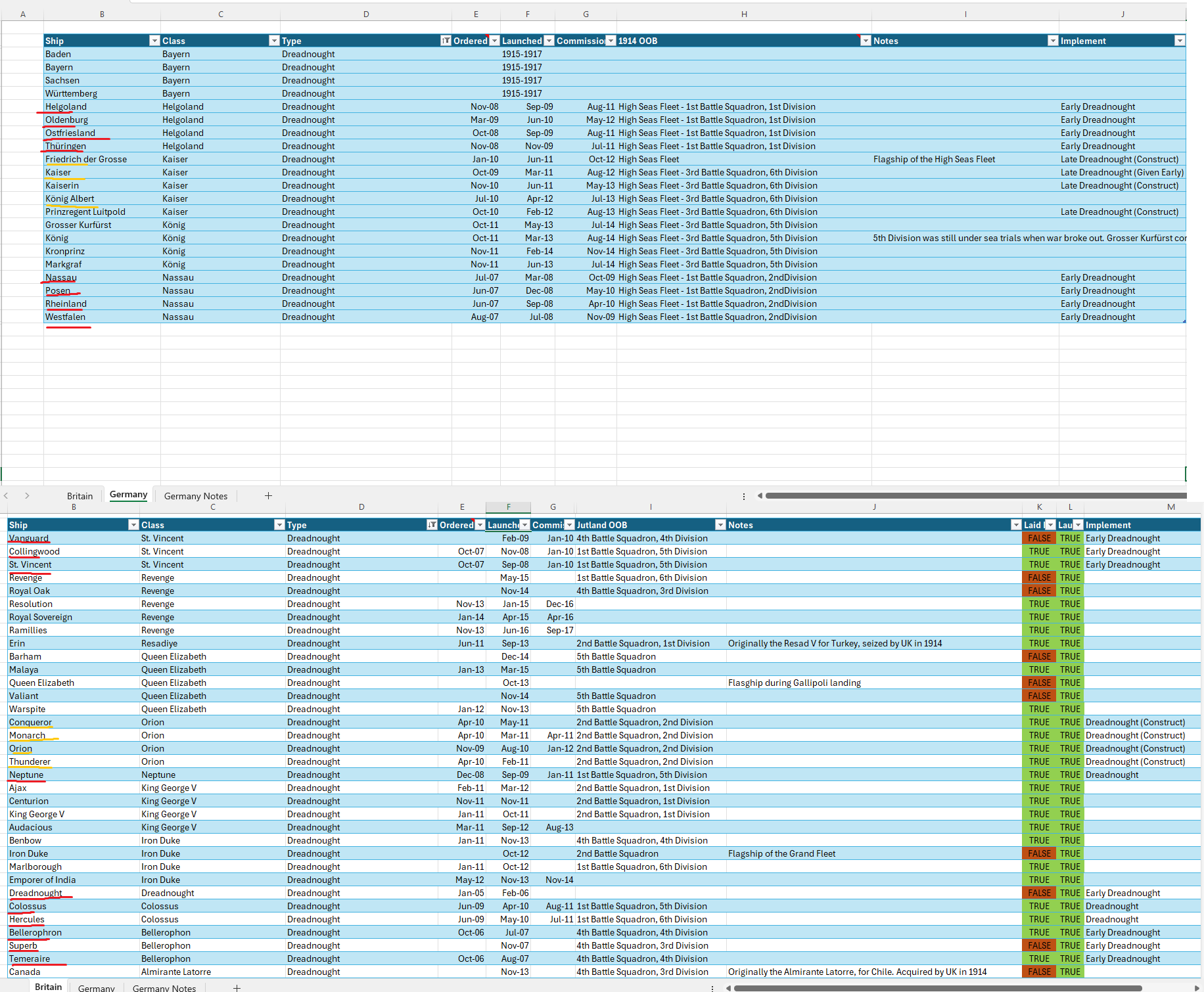
Overview of German (top) and British (bottom) dreadnoughts. This spreadsheet took weeks to make, and also details destroyers, cruisers, and a few smaller boats.
As always, deciding what to include is hard. All navies had a swarm of utility-boats, mine-layers, service boats, and more. None of these are usually included in HoI4, and including them would make the navy unmanageable.
Germany remained overshadowed, but it’s worth noting that most naval strategists believed they didn’t need to eclipse Britain to challenge her at sea: Britain’s navy was needed across the Empire, while Germany could concentrate hers in the North Sea.
Nonetheless, by 1911 Tirpitz was beggining to sweat. In 1912 he leant his support to the 3rd Naval Bill, which allocated yet more finance to the dreadnought programme.
By late 1912, however, sentiment in Germany finally faltered, and the Rüstungswende saw a return of naval spending to the army. Over the next two years, Britain would win the naval race in earnest, with 27 dreadnoughts to Germany’s 17.
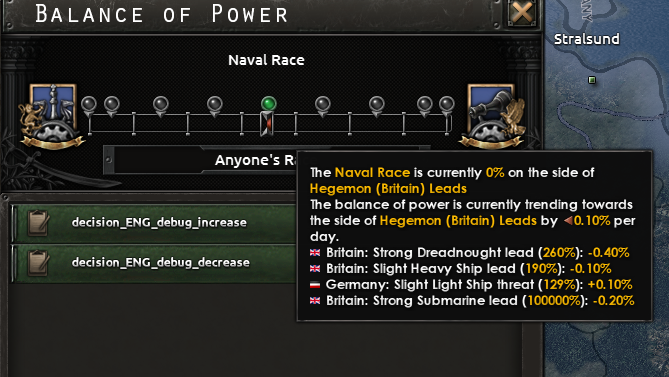
I originally didn’t have much intention of representing this race mechanically. But after some thought, I decided HoI4’s balance of power system was a perfect fit for it.
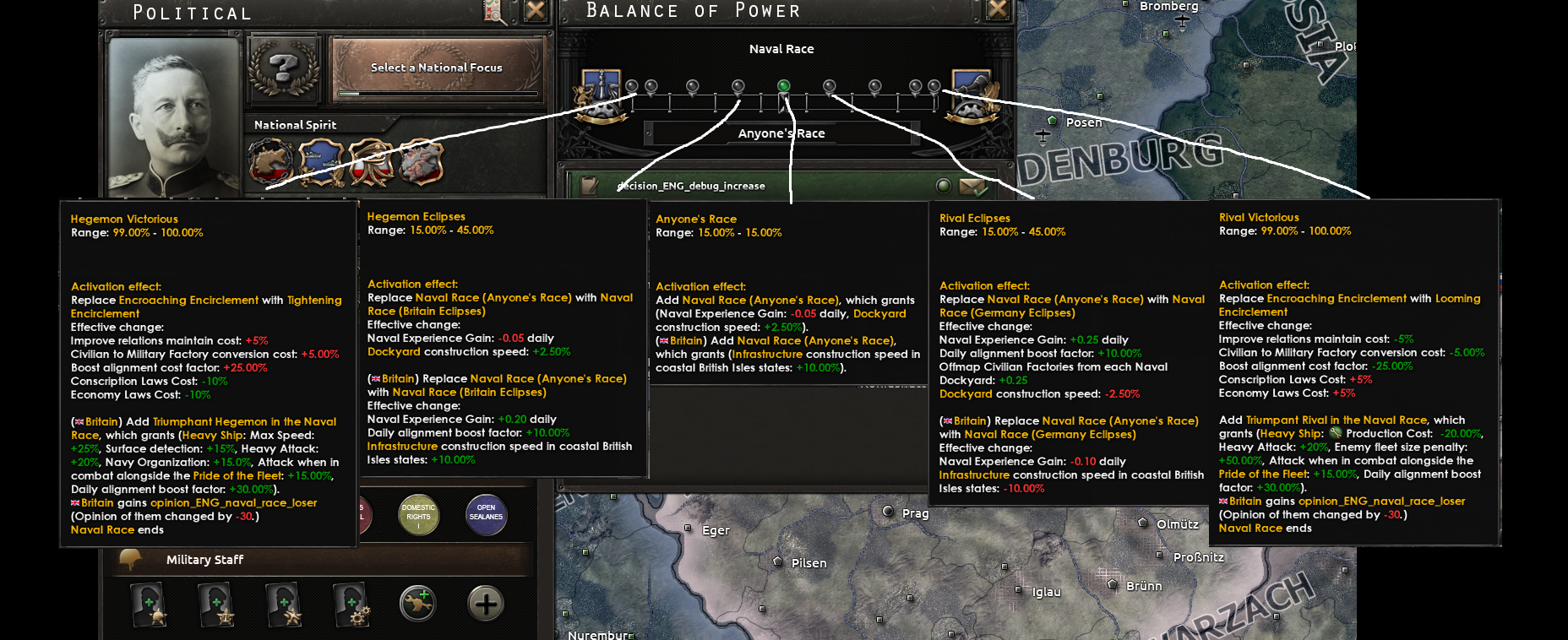
The balance of power is an all-purpose seesaw mechanic Paradox added to support assorted political struggles in HoI4.
A pip sits on the balance-of-power meter, and moves up or down depending on some factor.
In my case, it’s the proportion of German vessels to British ones.
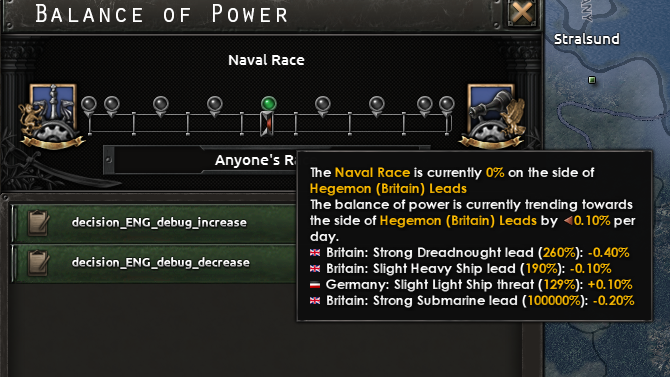
As mentioned, Germany doesn’t have to exceed British ships to start gaining balance of power. They simply have to reach about 2/3rds of Britain’s fleet in a given category.
As the pip moves, it enters different segments of the meter. Each segment conveys an effect.
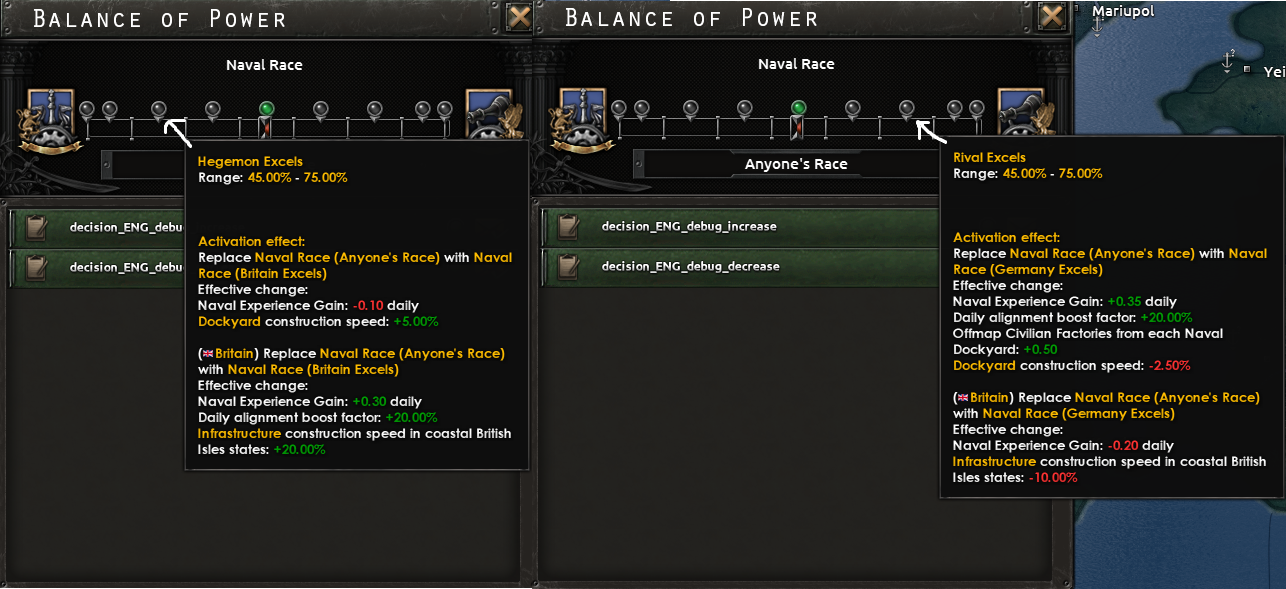
On the British side of the meter:
Britain gains naval experience
Britain can boost alignment in foreign countries more
Britain can build infrastructure faster on coastal regions (for the curious modders, I did this with dynamic modifiers)
Germany loses naval experience
Germany gains dockyard construction
That last one is to give a rubber-band effect. The Germans worked very hard to keep pace with the British.
On the German side of the meter:
Germany gains naval experience
Germany can boost alignment in foreign countries more
Germany gains free civilian factories for every naval factory (this is a special mechanic I implemented, and use in a few places)
Germany loses dockyard construction
Britain loses naval experience
Britain loses infrastructure building speed in coastal regions
At the end of the meter, each side can win the race. When that happens, the mechanic ends, and the winner gets a ‘trophy’ idea.
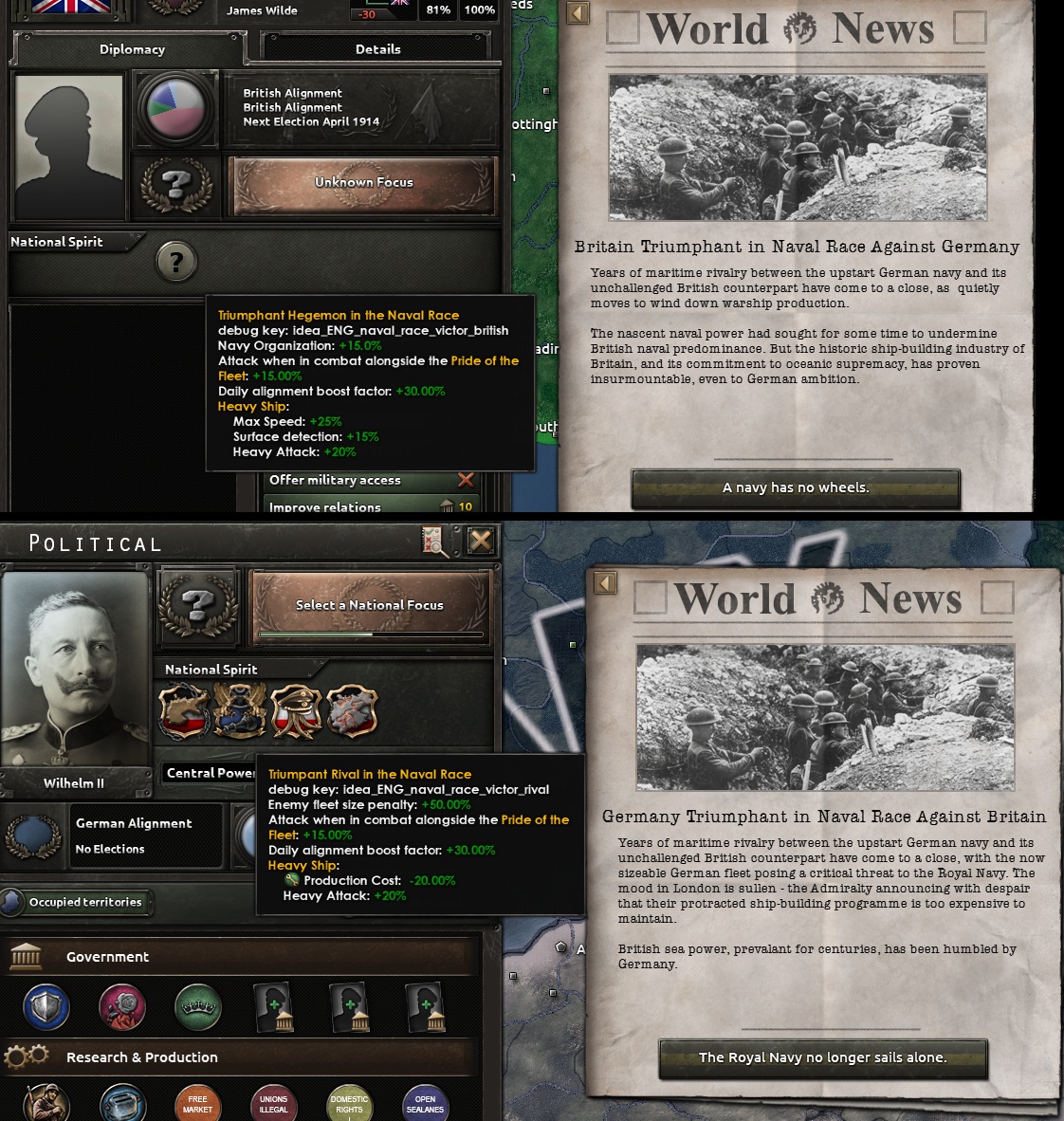
On top of that, Germany’s encirclement decreases if they win the race, and increases if they lose.
In Das Reich Aufzugehen
The last thing I’ll cover in this post is yet another mechanic where I was able to use the new diplomatic system.
While researching, I learned that a surprising amount of Germany’s troubles in the pre-war period centred on its federalism, finance in particular. As mentioned, Germany had confederated first its northern and then southern member states through wars of unification - though most of its constituent states joined willingly, many did so with reluctance, and the most powerful among them held onto priveledges of their own. These were the Reserve Rights (Reservatrechte).
An outline of these rights:
Bavaria, the most powerful constituent state, had an independent army during peacetime. It controlled its own railway and telegraph. Uniquely, Bavaria even held some ceremonial international recognition.
Württemberg, like Bavaria, had some army, railway, and telegraph independence. An automotive hub (Stuttgart is still known as ‘car city’), Württemberg was a major supplier of Germany machinery.
Baden had rights similar to, but less pronounced than, Württemberg. Home to the Black Forest and hugging the upper Rhine, Baden was a source of German construction materials. The Grand Duke of Baden was also known to be a well-liked diplomatic figure.
Saxony was federated earlier than the above states, but nonetheless commanded some influence in the federal system. It was also a critical centre of manufacturing and mining.
The Hanseatic Cities of Hamburg, Bremen, and Lübeck were the most liberal-minded in Germany (Hamburg in particular was known for its close relations with the British before confederation). On joining, these cities demanded free-trade areas in their city centres which would not be subject to German tariffs.
On top of this, Germany was one of the only powers in Europe with no national Income Tax. This meant that while individual member states could tax the income of their citizens, the imperial government (which had to pay for the army, the navy, and much aside) could not. In practice, this meant that as the size of the German army increased before the war, the national government was increasingly unable to fund it.
To represent all this, I added the Staatenbund mechanic.
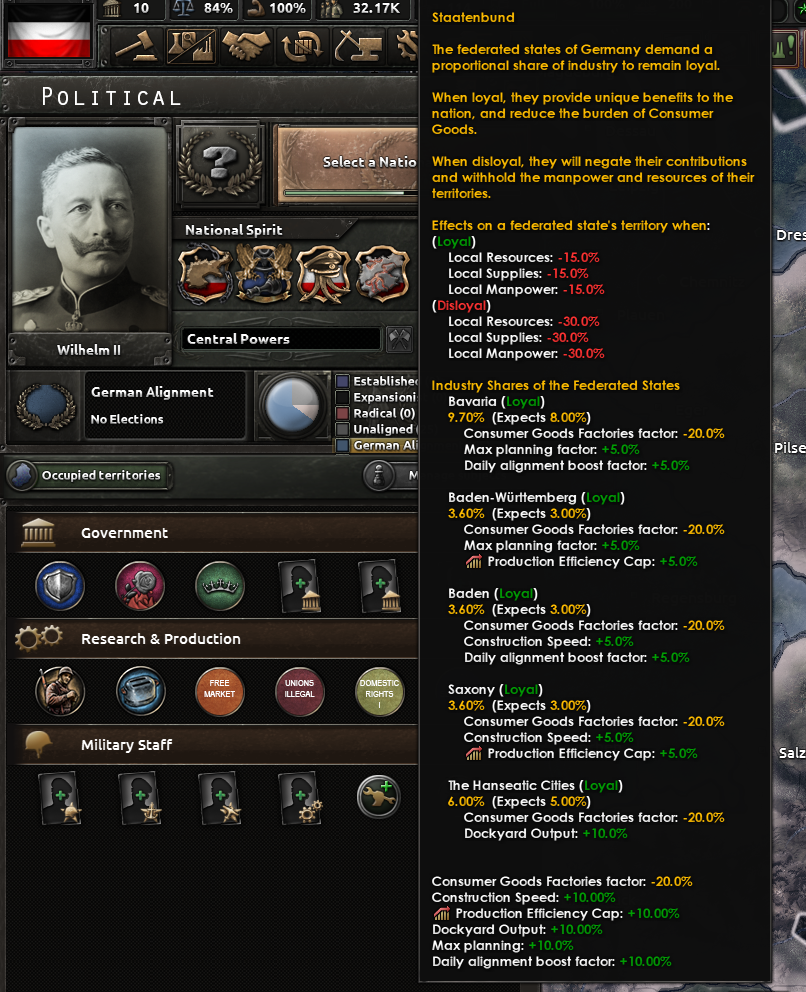
With the Staatenbund, Germany must build enough factories in its 5 member states, or they will become disloyal.
A loyal state convers a very slight bonus, unique to that state.
A disloyal state confers a malus, and quite a big one.
In addition, the Staatenbund idea increases Consumer Goods factories by a base level of 80% (this is very bad! it’s basically wasted factories). Each state contributes tax to help reduce this value, but only if the state is loyal (historically this represents the Matrikularbeitrag, or Matricular Contributions).
This principle that each state demanded a share of the empire’s industry comes from something I read in Niall Ferguson’s The Pity of War: German authorities were compelled to distribute military contracts evenly among the states, which proved very ineffective.
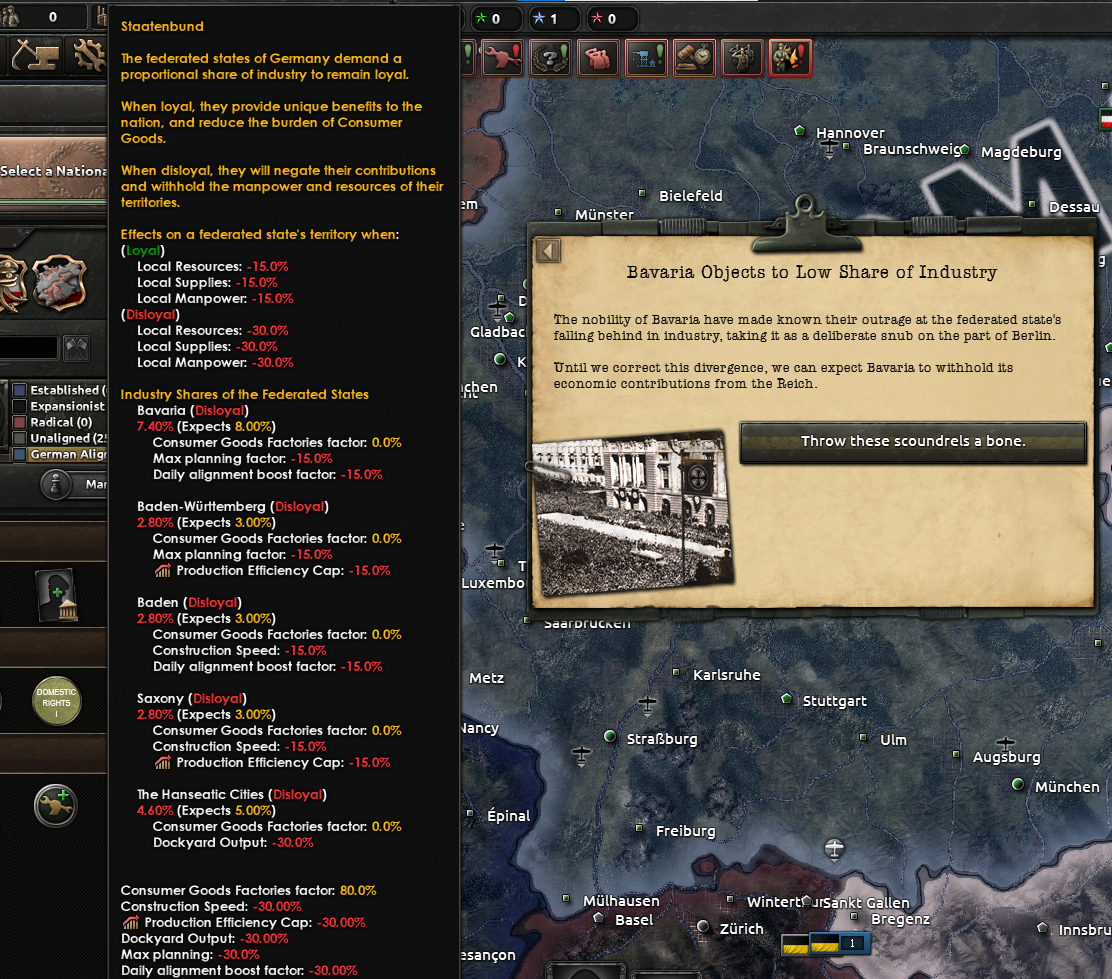
What can be done about the Staatenbund?
A lot. Using the focus tree, I plan to support:
Increasing or decreasing the percentage of industry each state expects
Increasing the bonuses given by a state
Adding new states (for example, Alsace-Lorraine, which in 1911 is essentially an occupied territory with no state rights)
Reforming the imperial system from a Staatenbund into a Bundestaat, reducing the need for Matricular Contributions
Abolishing federal Germany in favour of a centralised state (this is what the Nazis did)
I’d like to cover the German focus tree, as well as the changes I’ve made to the politics system to support it, in my next post.
Thanks for reading, and … Merry Christmas! I’m going to bed.